How Much Does a Website Cost in South Africa? (2026 Pricing Guide)

Trying to budget for a new website in South Africa can be a frustrating experience. You’re met with vague ‘it depends’ answers, wildly different quotes, and a constant fear of hidden costs. This ambiguity makes it nearly impossible to confidently answer the critical question: how much does a website cost in south africa 2026? A website is a powerful business asset, not a mysterious expense, and you deserve a clear path to achieving a significant return on your investment.
In this definitive pricing guide, we cut through the noise. We provide a realistic breakdown of website design prices in South Africa, from essential brochure sites to sophisticated e-commerce platforms. You’ll get a clear checklist of the factors that genuinely influence the final cost, empowering you to compare quotes intelligently, avoid overpaying for features you don’t need, and create a realistic budget for a website designed to perform and grow your business.
Website Price Ranges in South Africa for 2026: The Quick Answer
When business owners ask, “how much does a website cost in south africa 2026?”, the most accurate answer is: it’s an investment, not just an expense. A website is a primary business asset, a 24/7 sales engine engineered to generate leads, drive revenue, and enhance your brand’s authority. The price ranges below are baseline estimates for professional web development that delivers measurable results. They account for the strategy, design, and technical expertise required to build a site that performs—one that offers a significant return on your investment rather than becoming a forgotten digital brochure.
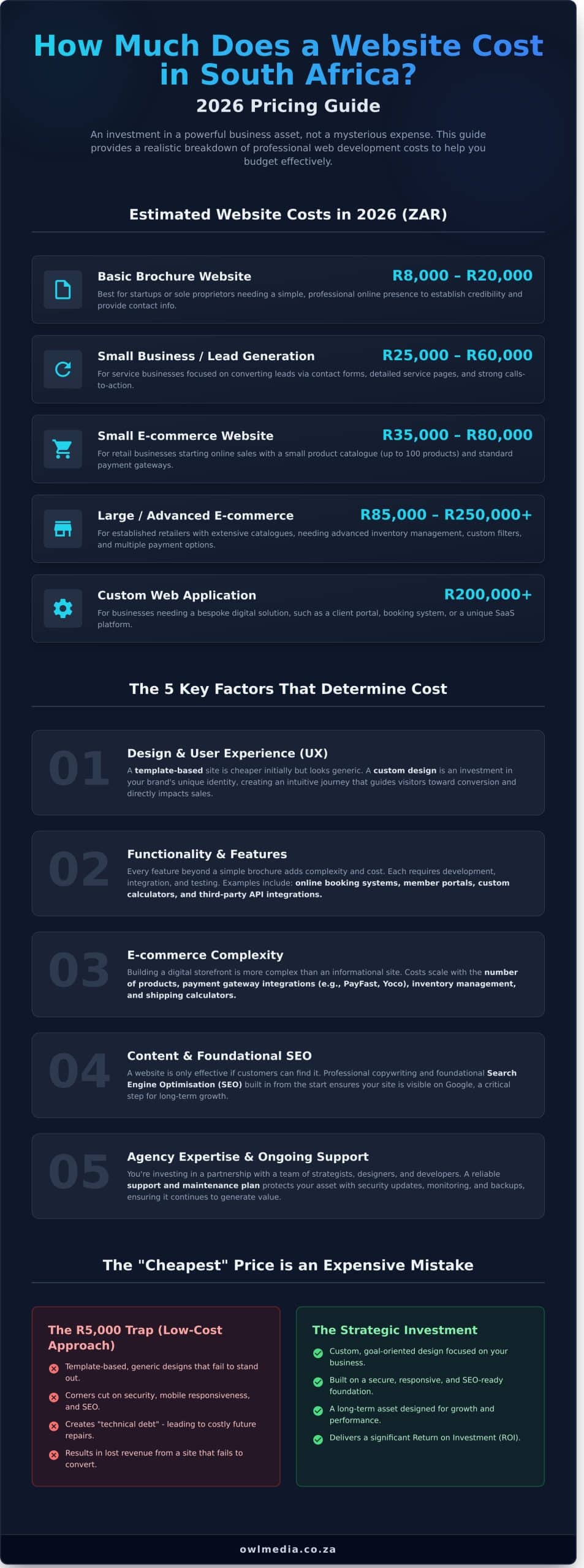
2026 Estimated Website Costs in South Africa (Table)
| Website Type | Price Range (ZAR) | Best For |
|---|---|---|
| Basic Brochure Website | R8,000 – R20,000 | Startups, sole proprietors, or businesses needing a simple, professional online presence to establish credibility and provide contact information. |
| Small Business / Lead Generation Website | R25,000 – R60,000 | Service-based businesses focused on attracting and converting leads through contact forms, detailed service pages, a blog, and strong calls-to-action. |
| Small E-commerce Website | R35,000 – R80,000 | Retail businesses starting their online sales journey with a small product catalogue (e.g., up to 100 products) and standard payment gateway integrations. |
| Large / Advanced E-commerce Website | R85,000 – R250,000+ | Established retailers with extensive product catalogues, requiring advanced features like inventory management, custom filters, and multiple payment options. |
| Custom Web Application | R200,000+ | Businesses needing a bespoke digital solution, such as a client portal, booking system, or unique software-as-a-service (SaaS) platform. |
Why You Shouldn’t Just Look for the ‘Cheapest’ Price
Choosing a web developer based solely on the lowest price is one of the most expensive mistakes a business can make. While a R5,000 quote might seem appealing, it often signals a template-based, rushed process that neglects your unique business goals. Ultra-low-cost providers frequently cut corners on critical elements like security, mobile responsiveness, SEO foundations, and user experience (UX). This creates significant “technical debt”—a situation where quick, cheap solutions lead to complex, costly problems down the line. Ignoring fundamental web design principles results in a site that is difficult to update, vulnerable to hacking, and invisible to search engines. The true cost isn’t the initial fee; it’s the missed opportunity of a website that fails to attract and convert customers, costing you far more in lost revenue and future repair bills.
The 5 Key Factors That Determine Your Final Website Cost
When asking “how much does a website cost in South Africa 2026?”, it’s crucial to understand that you’re not buying a product off a shelf; you’re investing in a tailored business asset. The final price is a direct reflection of the time, expertise, and strategic value built into it. Global benchmarks, like this comprehensive 2026 website pricing guide from Forbes, confirm that costs vary based on scope. Think of the following five factors as levers you can adjust to align the project with your budget and business objectives.
1. Design & User Experience (Template vs. Custom)
A template-based website offers a lower initial cost but often results in a generic look that restricts your brand’s potential. A custom design is an investment in your unique identity. It involves a strategic User Experience (UX) process to create an intuitive journey that guides visitors toward conversion, directly impacting your sales and lead generation. This is the marriage of form and function, designed to deliver measurable results.
2. Functionality & Features
Beyond a simple online brochure, every piece of functionality adds to the complexity and cost. Each feature is a custom-built tool for your business, requiring significant development, integration, and testing time. Common examples that increase scope include:
- Online booking and appointment systems
- Secure member portals with login capabilities
- Advanced contact forms or custom price calculators
- Integration with third-party software (CRMs, APIs)
3. E-commerce Complexity
An e-commerce website is fundamentally more complex than a standard informational site. You’re not just displaying information; you’re building a digital storefront to process transactions securely and efficiently. The cost scales with features like the number of products, integration with South African payment gateways like PayFast or Yoco, automated inventory management, and complex shipping calculators that enhance the customer experience.
4. Content & Foundational SEO
A powerful website is only effective if your customers can find it. While you can provide your own content, investing in professional copywriting and brand photography builds trust and authority. More importantly, foundational Search Engine Optimisation (SEO) is built in from the start. This includes keyword research, on-page optimisation, and technical setup to ensure your site is visible on Google from day one—a critical step for long-term growth.
5. Agency Expertise & Ongoing Support
Finally, who you choose to build your site is a major cost factor. A professional agency provides a holistic team of strategists, designers, and developers focused on your ROI. Beyond the initial launch, you are also investing in a partnership. A reliable support and maintenance plan protects your asset with regular security updates, performance monitoring, and backups, ensuring your website continues to perform and generate value for your business.
Who Should Build Your Website? Agency vs. Freelancer vs. DIY
Once you have a budget in mind, the next critical decision is choosing who will bring your digital vision to life. This choice directly impacts not only the final product but also its long-term performance and your return on investment. For South African businesses, the decision typically comes down to three paths, each with distinct advantages and trade-offs.
The DIY Route (Wix, Squarespace, Shopify)
Website builders offer the lowest initial cash outlay and give you complete control. However, this control comes at the cost of your time—a valuable resource for any business owner. While great for hobbyists or businesses on a shoestring budget, DIY platforms often create significant hurdles for technical SEO, have customisation limits, and can struggle to scale as your business grows. The initial saving can quickly be eroded by lost opportunities.
Hiring a South African Freelancer
A local freelancer offers a middle ground, providing a more professional result than DIY at a lower price point than an agency. This is an excellent option for small, well-defined projects where you have a clear brief. The primary risks are a limited skillset—a great designer may not be an expert developer or SEO strategist—and availability. You are hiring an individual, not a team, which can create a single point of failure if they become unavailable.
Partnering with a Digital Agency
Engaging a digital agency is an investment in a strategic partnership. While the initial cost is higher, you gain access to a multi-disciplinary team of experts dedicated to achieving your business objectives. The true value lies in their holistic approach, which ensures that every element of your site is built for performance. The question of how much does a website cost in south africa 2026 becomes a conversation about ROI, not just expense. A comprehensive Forbes 2026 website cost guide highlights that professional builds often have a lower total cost of ownership over time. An agency offers:
- Strategic Insight: A website aligned with your commercial goals.
- Diverse Expertise: A cohesive team of designers, developers, SEO specialists, and copywriters.
- Reliability and Support: A long-term partner invested in your growth and success.
For businesses serious about leveraging their website as a primary engine for growth, an agency provides the strategic foundation needed to dominate the market. See how Owl Media’s team builds websites that perform.
Beyond the Build: Hidden Costs to Budget For in 2026
Launching your new website is a significant milestone, but the initial development fee is only the first part of the story. To ensure your digital asset delivers a sustainable return on investment, it’s crucial to plan for ongoing operational costs. When asking how much does a website cost in south africa 2026, factoring in these recurring expenses provides a complete and realistic budget, preventing future surprises and protecting your initial investment.
Annual Essentials: Domain & Hosting
Think of your domain name (e.g., yourbusiness.co.za) as your digital address and web hosting as the land your website is built on. Both are non-negotiable annual renewals.
- Domain Name: Securing your .co.za domain typically costs between R100 and R300 per year.
- Web Hosting: This service keeps your site live on the internet. Basic shared hosting might start at R1,200 annually, while more robust VPS hosting for faster, more secure sites can range from R3,000 to R6,000+ per year. Your choice directly impacts your site’s speed and security.
Ongoing Needs: Maintenance, Security & Support
A website isn’t a “set it and forget it” asset. It’s a dynamic piece of software that requires consistent care to function optimally and securely. Regular software updates, security scans to block malicious attacks, and consistent backups are essential to prevent hacks and costly downtime. A professional monthly maintenance plan is the most effective strategy to keep your digital storefront secure, fast, and fully operational, safeguarding your business reputation.
Growth Accelerators: Marketing & Content
A high-performance website is only effective if your target audience can find it. To transform your site from a digital brochure into a lead-generation engine, you must invest in driving traffic. These ongoing activities are what generate a measurable return on your investment.
- Search Engine Optimisation (SEO): A long-term strategy to improve your ranking on Google and attract organic traffic.
- Digital Advertising: Using platforms like Google Ads to drive immediate, targeted visitors to your site.
- Content Creation: Regularly publishing valuable content like blog posts to engage your audience and boost SEO.
Understanding these essential ongoing expenses provides a much clearer picture of what your total digital investment will be. At Owl Media, we craft holistic digital strategies that incorporate ongoing support, ensuring your website continues to perform and deliver measurable business results long after launch.
Transforming Website Costs into a Powerful Investment
As we’ve explored, understanding website pricing in 2026 is about more than just a number; it’s about recognising the value of a strategic investment. The final cost is shaped by your unique business goals, the complexity of the features you need, and the expertise of the partner you choose. From the initial build to ongoing maintenance, every element contributes to the long-term success of your digital presence.
Ultimately, the answer to how much does a website cost in south africa 2026 depends on the return on investment you expect to achieve. A cheap website often becomes an expensive liability, while a strategic, results-driven site becomes a powerful asset for growth. It’s not just about getting online; it’s about getting measurable results.
At Owl Media, a full-service agency based in Centurion, we craft beautiful, intuitive websites designed to deliver a tangible ROI for our clients across South Africa. We focus on the marriage of form and function to ensure your investment grows your business. Ready to see what’s possible? Request a free, no-obligation website proposal and let’s start building the digital foundation your business deserves.
Frequently Asked Questions About Website Costs in South Africa
How much does a simple 5-page website cost in South Africa?
For a professional, well-designed 5-page business website in South Africa, you can expect to invest between R8,000 and R25,000 in 2026. This price typically includes a custom design, mobile-responsive development, a contact form, and basic on-page SEO. The final cost depends on the agency’s expertise and the complexity of the design. This investment provides a powerful digital foundation to attract and convert customers, delivering a tangible return on investment for your business.
What is the average hourly rate for a web developer in SA for 2026?
In 2026, the average hourly rate for a web developer in South Africa varies based on experience and whether you hire a freelancer or an agency. Freelancers typically charge between R450 and R900 per hour. Agencies, offering a more comprehensive team and process, generally charge from R750 to R1,500+ per hour. This rate is a crucial factor when calculating how much does a website cost in South Africa 2026, especially for projects requiring custom functionality.
Can I pay for a website in monthly instalments?
Yes, many South African web design agencies, including Owl Media, offer flexible payment plans to assist with your cash flow. A common structure is a 50% upfront deposit to commence the project, with the remaining balance split into monthly instalments over the development period. This approach makes a professional, high-performing website more accessible for startups and small businesses, allowing you to invest in a critical business asset without a prohibitive initial outlay.
How long does it typically take to design and build a business website?
The timeline for building a business website is directly linked to its complexity. A standard 5-10 page brochure-style website typically takes 4 to 6 weeks from the initial brief to launch. More complex projects, such as those with custom features or large e-commerce stores, can take anywhere from 8 to 12 weeks or more. Efficient collaboration, including timely feedback and content provision from your side, is key to meeting these timelines and launching your digital asset promptly.
Is e-commerce website pricing different from a standard website?
Absolutely. E-commerce website pricing is significantly different because the functionality required is far more complex. An online store needs secure payment gateway integration (like PayFast or Yoco), product catalogue management, inventory systems, and a secure customer checkout process. This additional development and security work is why the answer to “how much does a website cost in South Africa 2026” is higher for e-commerce, reflecting the platform’s direct role in generating revenue.
Why do I need to pay for website maintenance?
Website maintenance is a critical investment to protect your digital asset and ensure its continued performance. Regular maintenance involves crucial tasks like software updates, security scans to prevent hacking, performance optimisation for speed, and regular backups. Neglecting this exposes your site to security risks, slow load times, and potential crashes. A maintenance plan ensures your website remains a secure, fast, and reliable tool for growing your business and protecting your initial investment.