Ecommerce Website Design South Africa: The Ultimate Guide to Online Sales Success

Ready to launch a successful online store but feeling overwhelmed by the complexities of ecommerce website design south africa? The debate between Shopify and WooCommerce, confusion around local payment gateways like PayFast, and the fear of investing in a site that fails to generate sales can be paralyzing. For ambitious businesses, turning an idea into a profitable online venture is the goal, but the path forward often seems unclear, especially when competing with giants like Takealot.
This is where strategy meets execution. This ultimate guide is your comprehensive roadmap, designed to cut through the noise and provide clear, actionable steps. We will walk you through everything from planning your budget and choosing the right platform to integrating essential local couriers and payment systems. You’ll gain the clarity and confidence needed to build a high-converting online store that delivers a measurable return on investment and drives sustainable business growth.
The South African Ecommerce Landscape: Why Professional Design is Crucial
The South African digital marketplace is no longer emerging; it has arrived. With online retail sales experiencing explosive year-on-year growth, the opportunity for businesses is immense. However, this rapid expansion has also created a highly competitive environment. In this climate, a generic, off-the-shelf website template is simply not enough to capture market share. To succeed, you need professional ecommerce website design South Africa that is strategically crafted to meet the unique demands and expectations of local consumers. This isn’t just about looking good; it’s about building a powerful sales engine from the ground up, focusing on Conversion-Rate Optimisation (CRO) to turn visitors into paying customers.
Understanding the Modern South African Online Shopper
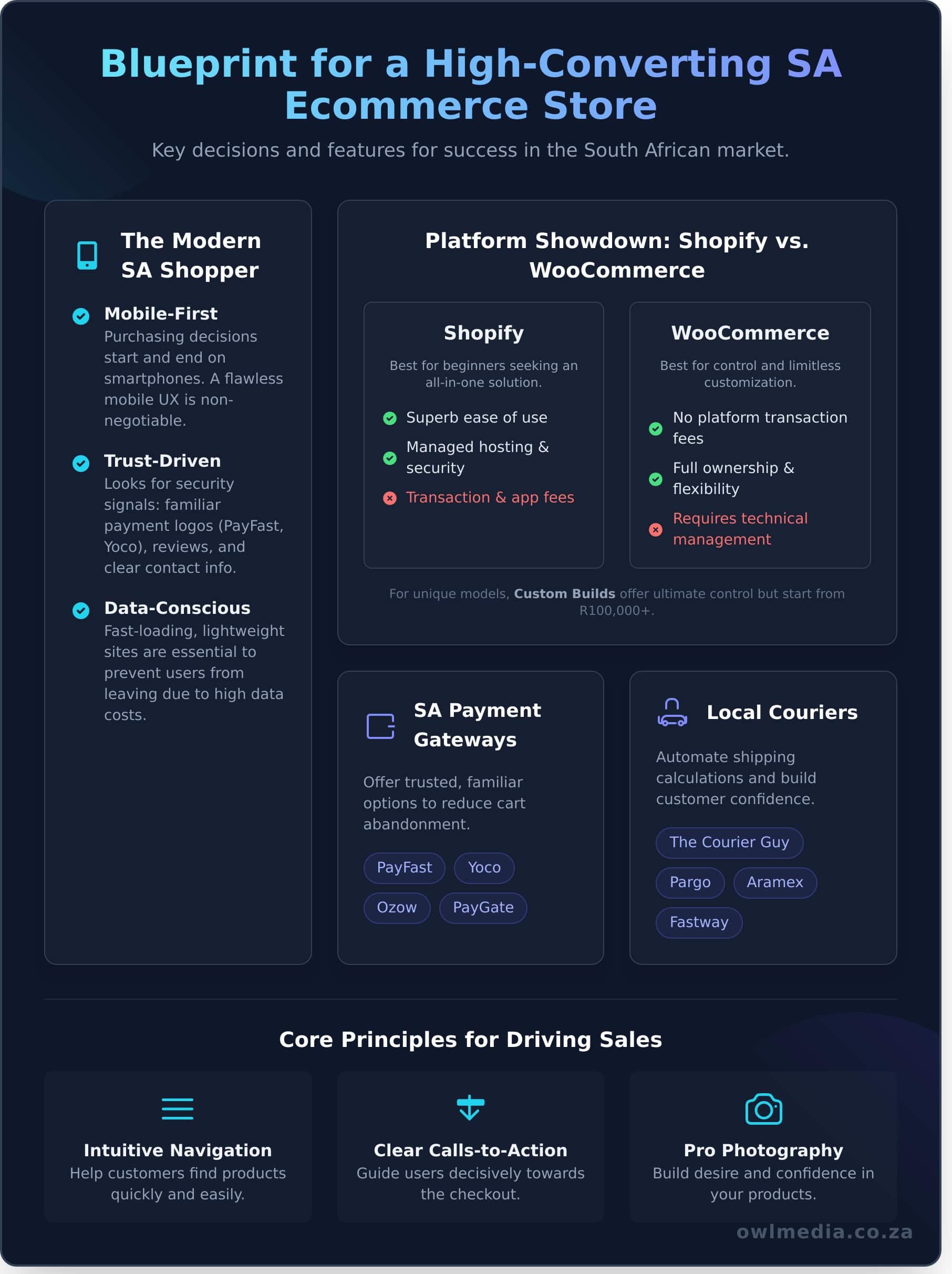
South African consumers are savvy, cautious, and overwhelmingly mobile-first. Your store must deliver a flawless experience on a smartphone, where most purchasing decisions begin and end. Crucially, trust is a major factor. Shoppers look for clear trust signals like visible contact details, customer reviews, and familiar, secure payment gateways such as PayFast or Yoco. Furthermore, with high data costs being a reality for many, a fast-loading, lightweight website isn’t a luxury—it’s essential for keeping potential buyers engaged and on your site.
First Impressions Matter: The ROI of Credibility
In ecommerce, your website’s design is a direct reflection of your brand’s quality and trustworthiness. A cluttered, slow, or unprofessional-looking site instantly raises red flags, leading to high bounce rates as users quickly click away. In contrast, a clean, polished, and intuitive design builds immediate credibility. This initial positive user experience (UX) is the first step in fostering a relationship, encouraging brand loyalty, and securing the repeat business that drives sustainable growth. A strong visual identity makes you memorable and positions you as a leader in your niche.
Beyond Aesthetics: How Strategic Design Drives Sales
Effective ecommerce design is the perfect marriage of form and function. While the aesthetics draw customers in, it’s the underlying strategy that converts them. This involves implementing core UX principles to create a seamless path to purchase:
- Intuitive Navigation: Helping customers find what they need quickly and easily.
- Clear Calls-to-Action (CTAs): Guiding users decisively towards the checkout.
- Professional Product Photography: Building desire and confidence in your offerings.
Ultimately, investing in professional ecommerce website design South Africa isn’t an expense; it’s a direct investment in your sales infrastructure, engineered to deliver a measurable Return on Investment (ROI) and set you apart from the competition in the thriving global ecommerce landscape.
The Blueprint for Success: Key Decisions Before You Build
A beautiful storefront is useless without a solid business plan. The most successful online stores are built on strategic decisions made long before the first pixel is placed. This foundational phase of ecommerce website design south africa involves defining your target audience, crafting a unique selling proposition (USP), and making critical technology choices. Getting this blueprint right ensures your platform is not just functional, but engineered to boost sales and deliver a measurable return on investment.
Choosing Your Platform: Shopify vs. WooCommerce vs. Custom Builds
The engine of your online store is your eCommerce platform, and your choice impacts everything from daily management to long-term scalability. For South African businesses, the main contenders are:
- Shopify: An all-in-one solution ideal for beginners. It offers superb ease of use and managed hosting, but transaction fees and monthly app costs can accumulate.
- WooCommerce: A powerful and flexible plugin for WordPress. It gives you limitless customisation and control with no platform transaction fees, but it requires more hands-on technical management.
- Custom Builds: The ultimate solution for unique business models or complex integrations. This path offers unparalleled control but involves a significant upfront investment, often starting from R100,000 or more.
Integrating Local Payment Gateways Seamlessly
Trust is the currency of eCommerce. Offering familiar, secure payment options is non-negotiable for reducing cart abandonment. Integrating trusted South African gateways like PayFast, Yoco, Ozow, and PayGate is essential. When choosing, compare transaction fees, ease of setup, and security features. Ensuring your checkout process is compliant is also critical; you can learn more about the specific South African eCommerce regulations to ensure you’re fully prepared. A robust strategy prioritises a frictionless payment experience.
Solving the Logistics Puzzle: South African Courier Integration
Getting your products to customers efficiently is the final, crucial step. Your eCommerce platform must integrate seamlessly with major local couriers like The Courier Guy, Pargo, Aramex, and Fastway. This allows for automated, real-time shipping calculations at checkout, which builds customer confidence. You can then leverage different shipping strategies to enhance conversions, such as offering a flat rate for simplicity or a free shipping threshold (e.g., on orders over R750) to increase average order value.
From Concept to Conversion: Essential Features of a High-Performing SA Store
A beautiful online store is only effective if it converts visitors into paying customers. The success of your digital storefront hinges on a strategic marriage of form and function, where every element is crafted to guide the user seamlessly from discovery to purchase. Effective ecommerce website design south africa prioritises an intuitive user experience (UX) built on a foundation of robust, sales-focused features tailored for the local market.
Mobile-First Design: Winning on the Small Screen
With a significant portion of South African online traffic coming from mobile devices, a responsive design is non-negotiable. This means your site must provide a flawless experience on a smartphone, not just shrink to fit. We craft mobile journeys with large, tappable buttons, streamlined navigation, and compressed images for fast loading on mobile networks. Consider the checkout process on a site like Takealot—it’s simple, fast, and built for the small screen.
High-Converting Product Pages
Your product page is your digital sales pitch. It must answer every potential question and build desire for the product. We ensure every page includes:
- High-Quality Visuals: Multiple product images and, where possible, video.
- Compelling Descriptions: Copy that sells the benefits, not just the features.
- Clear Pricing: All costs displayed in Rand (R), with no hidden fees.
- Social Proof: Prominently displayed customer reviews and ratings to build trust.
An Effortless Checkout Process
Cart abandonment is the enemy of profit. A complicated checkout is a primary cause. We reduce friction by implementing guest checkout options, progress indicators, and displaying all costs upfront, including delivery fees and VAT. Building trust at this critical stage is paramount, which is why we secure every site with SSL certificates. Adhering to best practices also ensures your store aligns with consumer protection standards outlined in South Africa’s ecommerce regulations, further boosting customer confidence.
Launching and Growing Your Online Store
A successful launch is a critical milestone, but it’s the beginning of your journey, not the final destination. The most effective ecommerce website design South Africa projects are backed by a robust, post-launch growth strategy. Once your digital doors are open, the focus shifts to attracting qualified traffic, converting visitors into customers, and fostering long-term loyalty. This is where a strategic digital marketing plan becomes essential for achieving a significant return on your investment.
At Owl Media, we view ourselves as your long-term growth partner. We craft holistic strategies that transform your new website from a static online brochure into a dynamic, sales-generating machine.
Foundational SEO for Ecommerce
Search Engine Optimisation (SEO) is the process of making your store visible to customers actively searching for your products on Google. It starts with meticulous keyword research for your product and category pages to capture high-intent traffic. Our technical SEO ensures your site is fast, mobile-friendly, and easily crawled by search engines—all critical ranking factors. A supporting content strategy, like a blog, helps you attract customers at every stage of their buying journey.
Driving Targeted Traffic with Paid Ads
Paid advertising delivers immediate, targeted traffic to your online store. For South African ecommerce businesses, key channels include:
- Google Shopping Ads: These place your products directly in front of customers on the search results page, complete with image, price, and store name, leading to higher click-through rates.
- Social Media Ads: Platforms like Facebook and Instagram allow you to target users based on demographics, interests, and behaviour, perfect for building brand awareness and driving sales within specific provinces or cities.
- Remarketing: This powerful tactic re-engages visitors who left your site without purchasing, reminding them of the products they viewed and encouraging them to complete their order.
Measuring What Matters: Essential Analytics
You can’t improve what you don’t measure. We help you track Key Performance Indicators (KPIs) to make data-driven decisions. Using tools like Google Analytics, we monitor customer behaviour and focus on metrics that directly impact your bottom line, such as Conversion Rate (the percentage of visitors who buy), Average Order Value (AOV), and Customer Lifetime Value (CLV). This focus on measurable results ensures your marketing budget is always working to boost your sales and grow your business.
Ready to turn your website traffic into tangible revenue? Explore our digital marketing services and let’s build a strategy for sustainable growth.
Choosing Your Ecommerce Design Partner in South Africa
Selecting the right agency for your ecommerce website design South Africa project is one of the most critical business decisions you’ll make. Your chosen partner won’t just be a supplier; they will be instrumental in your company’s growth. A local South African agency offers an invaluable advantage, possessing an intrinsic understanding of the market, from popular payment gateways like PayFast and Yoco to the logistics of local courier services and the unique behaviour of South African online shoppers.
Key Questions to Ask Any Agency
To ensure you’re choosing a partner invested in your success, arm yourself with these essential questions:
- Do you have a portfolio of successful ecommerce websites? Look beyond aesthetics. Ask for live examples and analyse their performance. Is the user experience intuitive? Is the checkout process seamless? Do these sites look like they effectively convert visitors into customers?
- What is your process from initial brief to launch? A professional agency will have a transparent, structured process covering discovery, strategy, design, development, and testing. They should be able to provide a clear timeline and milestones.
- What post-launch support and maintenance do you offer? An ecommerce store is a living asset. Ask about ongoing support packages, security updates, and performance monitoring to ensure your investment remains secure and effective long after launch.
Red Flags to Watch Out For
Steer clear of agencies that exhibit these warning signs:
- Unrealistically low prices or vague quotes. A professional ecommerce build is a significant investment, often starting from R30,000+. Rock-bottom prices often mean corners are being cut on crucial elements like security, SEO, or user experience. Always demand a detailed, itemised quote.
- Lack of a clear process or poor communication. If an agency is disorganised or slow to respond during the sales process, it’s a strong indicator of how they’ll operate once they have your business.
- No access to a portfolio or client testimonials. A reputable agency will be proud of their work and happy to share case studies and connect you with past clients. A lack of evidence is a major red flag.
The Owl Media Difference: A Partnership for Growth
At Owl Media, we see ourselves as more than just web designers; we are your strategic partner in digital growth. We design and build ecommerce platforms with one primary objective: to deliver a measurable Return on Investment. Our expertise isn’t confined to beautiful design; it extends to the data-driven digital marketing strategies required to attract qualified traffic and convert it into sales.
We don’t offer cookie-cutter solutions. Instead, we engage in a collaborative process to understand your brand, your audience, and your commercial goals. This allows us to craft a holistic online experience that not only looks exceptional but functions as a powerful engine for your business.
Let’s build an ecommerce store that performs. Get in touch today.
Your Next Step to Ecommerce Success in South Africa
Building a successful online store in South Africa goes beyond a simple checkout cart. It demands a strategic blueprint, a deep understanding of the local market, and a commitment to creating a seamless user experience that converts browsers into buyers. From choosing the right platform to integrating local payment gateways, every decision is a crucial step toward sustainable growth.
Investing in professional ecommerce website design south africa is the most critical decision you’ll make. It’s not an expense; it’s the foundation of your digital business and your most powerful sales tool.
At Owl Media, we are a local South African team dedicated to building that foundation. We are experts in the marriage of form and function, blending beautiful design with results-driven digital marketing. Our portfolio of high-performing ecommerce websites is a testament to our ability to craft online stores that deliver a tangible return on investment.
Ready to transform your online presence into a sales powerhouse? Contact Owl Media for a free consultation and let’s start building your success story.
Frequently Asked Questions
How much does an ecommerce website cost in South Africa?
The investment for professional ecommerce website design South Africa varies based on your specific business objectives. A starter package using a robust template can range from R15,000 to R30,000. For businesses requiring more custom features, unique design, and complex integrations, costs typically fall between R35,000 and R70,000+. We provide a detailed proposal outlining all costs to ensure a clear return on your investment and sustainable growth for your business.
How long does it take to build a professional online store?
A professional online store can typically be designed, built, and launched within 6 to 8 weeks. This timeline allows for our strategic process, including discovery, design, development, and testing. The final duration depends on the project’s complexity, the number of products, and the speed of client feedback and content provision. We establish a clear project plan from the outset to ensure a timely and efficient launch that gets you selling sooner.
Can I manage and update my ecommerce website myself?
Absolutely. We build our ecommerce websites on intuitive platforms like Shopify and WooCommerce, which feature user-friendly dashboards. This empowers you to manage day-to-day operations with confidence, including adding new products, updating prices, and processing orders. We provide comprehensive training upon handover, ensuring you have the skills and control needed to run your online store efficiently and independently without relying on a developer for simple changes.
What is the best ecommerce platform for a small business in South Africa?
For most small businesses in South Africa, the choice is often between Shopify and WooCommerce. Shopify offers an excellent all-in-one solution with predictable monthly fees, perfect for those who prioritise ease of use. WooCommerce, built on WordPress, provides unparalleled flexibility and customisation, making it ideal for businesses with unique requirements. The best choice depends entirely on your specific goals, budget, and long-term growth strategy, and we help you make that strategic decision.
Do I need to register my online business in South Africa?
Yes, to operate legally and build credibility, you should register your online business. In South Africa, this means registering your business name and structure (e.g., Sole Proprietor or Pty Ltd) with the CIPC. Once you start earning, you will also need to register with SARS for tax purposes. Formalising your business is a critical step that protects you, enables you to open a business bank account, and builds essential trust with your customers.
How do I handle returns and refunds for my online store?
Handling returns effectively is key to building customer trust. We recommend creating a clear, concise Returns and Refunds Policy that is easily accessible on your website and compliant with South Africa’s Consumer Protection Act (CPA). Your ecommerce platform can be configured to manage the returns process, from customer requests to issuing refunds or store credit. A transparent and fair policy not only ensures legal compliance but also enhances the overall customer experience and encourages repeat business.